
Mecosta Projected and Actual Release
“Projected release date” is the reader's broad question, not Michigan's main legal label. The Michigan Department of Corrections uses Earliest Release Date, Maximum Discharge, and Date Paroled. Each answers a different question. Earliest Release Date marks the point when the Michigan Parole Board first gains jurisdiction. Maximum Discharge is the lawful maximum-term endpoint if an earlier parole does not occur. Date Paroled records when the person left prison or camp, or when parole status was conferred in another supervised setting.
None of those labels should be transferred to a jail-only Mecosta County case. A pretrial detainee can leave after bond, a court order, dismissal, or another event, but another case or detainer may keep that person in custody. A sentenced county-jail inmate's timing comes from the judgment, jail credit, later court orders, and the jail's operational calculation. A person moved from the Mecosta County Jail to MDOC has left the county facility, but has not been released from state custody.
Mecosta State Release Date Fields
The MDOC Offender Tracking Information System, known as OTIS, covers state prisoners, parolees, felony probationers, and discharged people still within its public retention window. It excludes people serving only a county-jail sentence. Search by the six-digit MDOC number when possible. A name search requires careful identity checks using date of birth, physical description, aliases, photo when available, and conviction details.
OTIS was reporting “Search is currently unavailable” on the research date. An outage does not change the field definitions, but it does prevent a live date lookup until service returns. The official OTIS scope page shown below is a proper starting point for a Mecosta state-prison case.
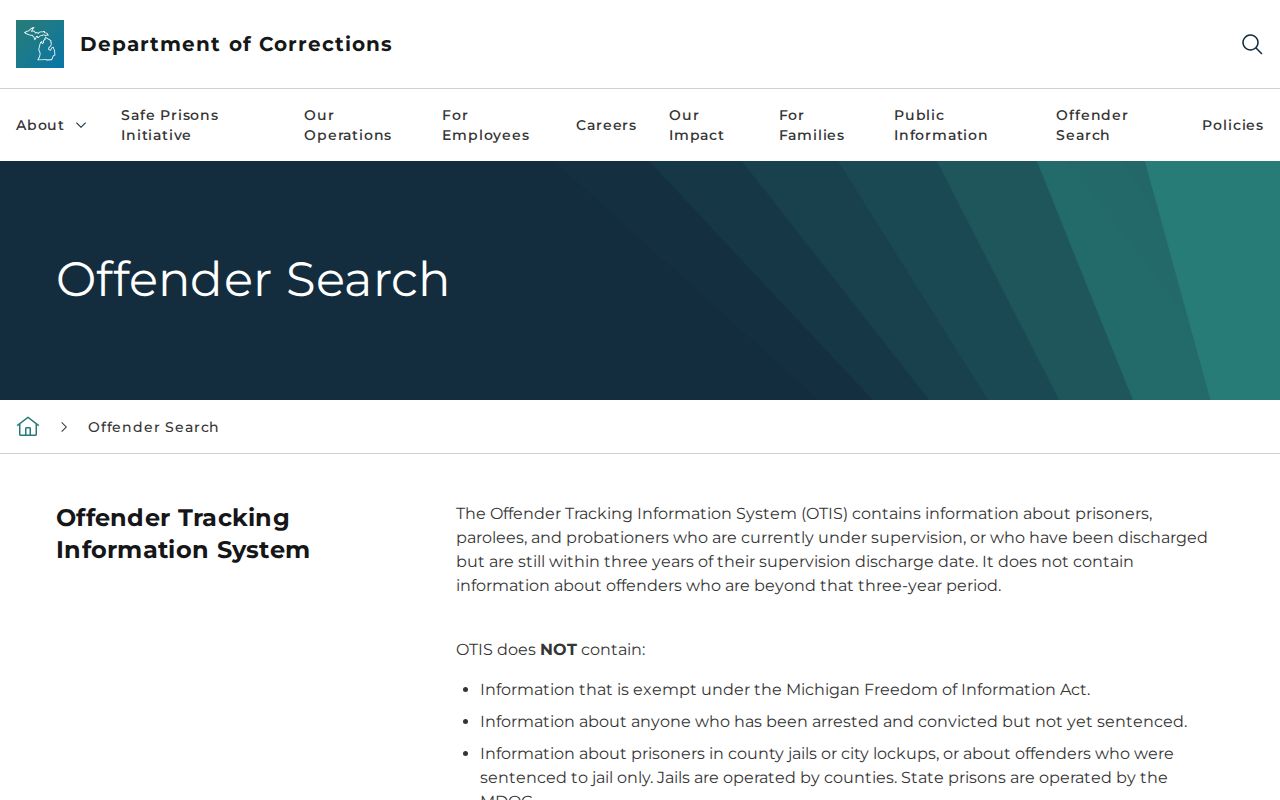
The screen identifies the state system; it should never be described as the Mecosta County Jail roster or as proof of a jail-only release.
Public OTIS access also has a time limit after the sentence ends. MDOC generally removes a fully discharged person three years after supervision discharge. For past-prisoner records up to six years after release, the department points requesters to MDOC Records Retention. Pre-1980 questions may require the Archives of Michigan. Those routes can recover context that no longer appears in a public search, but an older criminal-history response is not the same as a facility release certificate. Ask for the specific discharge, sentence, or time-calculation record needed and include the full name, date of birth, MDOC number when known, and a date range.
| OTIS label | What it means | What it does not prove |
|---|---|---|
| Earliest Release Date | First point of Parole Board jurisdiction | A scheduled exit or guaranteed grant |
| Maximum Discharge | Maximum lawful sentence endpoint | That parole cannot occur earlier |
| Date Paroled | Past departure into parole status | That all state supervision ended |
| Discharged | MDOC jurisdiction has ended | The exact county-jail release event |
Find a Mecosta Release Date
The right search path turns first on custody type. OTIS is for a state sentence or state supervision. The Mecosta County Jail and the local courts handle county custody and jail-only sentences. A federal sentence belongs in the Bureau of Prisons locator, while immigration custody belongs in ICE systems. Mixing those sources can produce a correct date for the wrong custody event.
- Identify the holding authority. Ask whether the person remains at the Mecosta County Jail, entered MDOC custody, or moved to another authority.
- For an MDOC case, search OTIS by MDOC number or legal name and confirm the person's identity before reading any date.
- Read Earliest Release Date with Maximum Discharge, current status, sentence data, and any Date Paroled. Do not treat one field as the whole answer.
- For a county-jail sentence, review the public court chronology for the judgment, jail credit, and later orders, then ask jail records for the operational release date.
- For a pretrial case, check bond and court orders, then call the jail to ask whether release or transfer actually occurred.
- Use a written sheriff or MDOC records request when a durable release or discharge record is needed.
A court order authorizing release does not timestamp the person's physical departure. Another case, warrant, or detainer may still control. For the same reason, reaching an MDOC eligibility date does not show that the Parole Board granted release.
Note: The Mecosta County jail record, court judgment, and OTIS record answer different parts of the release-date question.
Mecosta Truth-in-Sentencing Release Rules
Michigan does not use a broad rule that a modern prisoner serves about 85 percent of the minimum. The state's Truth in Sentencing information says covered prisoners serve 100 percent of the judicially imposed minimum term in prison before parole consideration. The rule applies to specified assaultive offenses committed on or after December 15, 1998, and to all other offenses committed on or after December 15, 2000.
That rule means the minimum term creates a threshold for Board jurisdiction, not a guaranteed release day. Michigan generally uses indeterminate state sentences with both a minimum and maximum. The court sets those terms. MDOC calculates the sentence from the judgment and applicable law. Once the lawful minimum is reached, the Board may consider parole under standards that include risk, conduct, programming, and other factors. MCL 791.233 supplies the parole grant standard, while MCL 791.234 governs Board jurisdiction and key eligibility rules.
The official Michigan truth-in-sentencing page pictured below states the 100%-minimum framework and its applicability dates.
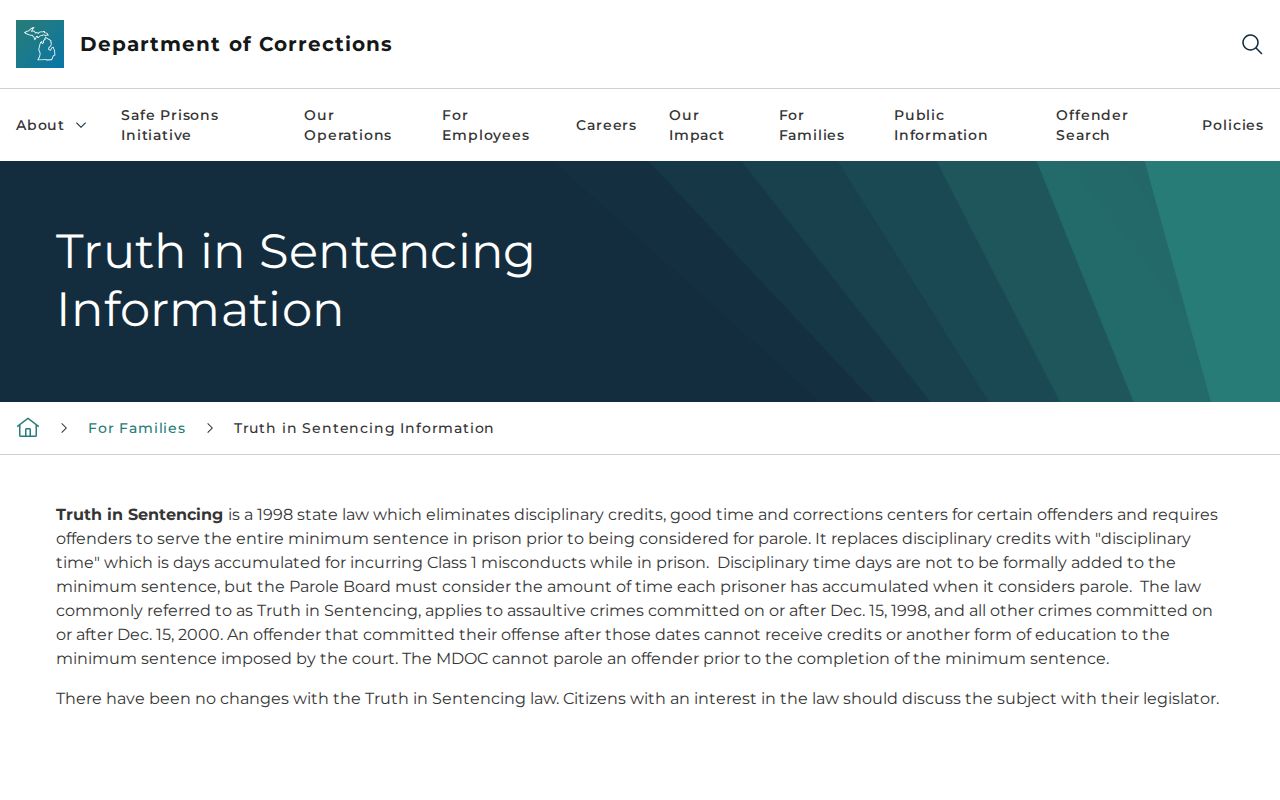
Its rule applies to covered MDOC sentences, not to a pretrial stay or a jail-only sentence at the Mecosta County Jail.
Michigan Release Calculation for Mecosta
Michigan's distinctive rule is date-specific. Good time is not available for crimes committed after April 1, 1987. Modern truth-in-sentencing cases also receive no good-time or disciplinary-credit reduction of the judicial minimum. Class I misconduct can instead produce disciplinary time. MDOC explains that this time is not formally added to the minimum sentence, but the Parole Board must consider it. MCL 800.34 and MDOC Policy Directive 03.01.105 govern that modern framework.
Older sentences require a different analysis. Historically applicable disciplinary credits can advance eligibility by five days for each month served, plus as many as two more days for exceptionally good behavior, up to 84 days per year. Major misconduct can cause a loss. MCL 800.33 contains those older provisions. The offense date and sentence type therefore matter. Applying old credit rules to a modern Mecosta state case would create a false date.
MDOC starts with the Judgment of Sentence, then accounts for the minimum and maximum terms, lawful jail credit, concurrent or consecutive structure, offense date, and the credit regime that legally applies. “Concurrent” means terms run at the same time. “Consecutive” means one term follows another. Court corrections, amended sentences, or revised jail credit can change the calculation after an initial date appears.
Mecosta Jail Release Date Calculations
OTIS does not calculate a jail-only Mecosta sentence. The official county page identifies Brian Miller as sheriff and the Sheriff's Office as the jail operator. Start with the judgment from the 77th District Court or 49th Circuit Court, depending on the case. Review the jail-credit entry and any later order that amends, vacates, or clarifies the sentence. Then ask the Mecosta County Jail for the operational date in its record. The jail line, 231-592-0156, is answered 24 hours a day.
No official Mecosta County source was found that publishes a county-jail good-time formula, weekend-release practice, holiday-advance rule, release-processing hour, or online projected-date field. Those gaps should remain explicit. MDOC prison rules cannot be copied onto the county jail. If an exact county date must be documented, request the booking and release record from the Sheriff's Office and specify the person, booking range, release date and time, release type, and any transfer destination.
A county transfer can also end one record without ending custody. A person sent from the jail to MDOC, another county, federal authorities, or another custodial setting has left Mecosta's facility but has not necessarily entered the community. Ask “release or transfer?” before relying on a date.
Why Mecosta Release Dates Change
A release-date field can move for lawful reasons. Some changes come from the sentencing court. Others come from the credit calculation, Parole Board process, conduct review, or a new custody claim. The source of the change determines where to verify it. A revised judgment belongs with the court and MDOC calculation staff; a parole outcome belongs with the Board and OTIS; a county hold belongs with the jail and originating agency.
| Factor | Possible effect | Where to verify |
|---|---|---|
| Corrected jail credit | Changes time already credited against a term | Sentencing court and MDOC |
| Amended or vacated sentence | Changes the terms used in calculation | Court order, then OTIS |
| Concurrent or consecutive clarification | Changes how multiple terms run | Judgment and MDOC records |
| Applicable older credits or misconduct | May alter eligibility or Board review | MDOC time calculation and policy |
| Parole grant, denial, or deferment | Moves the likely departure point | Michigan Parole Board and OTIS |
| New detainer or hold | May cause transfer or continued custody | Holding and receiving agencies |
Even a parole grant has a timing layer. MDOC says at least 28 days must pass between a release decision and physical release. Placement work, notices, appeal, new information, misconduct, or suspension may add more time. A projected date should be checked again near the event.
Confirm Mecosta Actual Release Dates
For an MDOC case, Date Paroled is stronger evidence of past departure than Earliest Release Date. A “parole” status means the person is outside ordinary prison custody but remains supervised. “Discharged” means MDOC jurisdiction ended. The MDOC date definitions pictured below explain those labels and the three-year public display rule.
The definitions show why one date cannot stand alone. Identity, current status, sentence data, and the holding authority must still agree.
Michigan VINE may send a custody-change alert for a participating agency, but its coverage and timing depend on the source feed. Treat an alert as a prompt to call the jail or MDOC. The Mecosta VINELink inmate search explains the specific-person alert process. For a county event, the jail and sheriff release record remain the direct sources. For the broader county search and court route, use the Mecosta County released-inmate lookup.
Note: A release alert can lag or describe transfer, so confirm the event with the agency that held the person.