
Mecosta Parole and Probation Compared
Parole follows a term of confinement in a Michigan prison. The Michigan Parole Board is the sole paroling authority for felony offenders committed to the Michigan Department of Corrections, or MDOC. A person on parole has left prison but remains under MDOC jurisdiction in the community. MDOC says parole commonly lasts from one to four years. Probation begins with a court order. It may follow a county jail term, or it may be imposed without any prison stay. The court keeps legal jurisdiction while the person follows the order and reports as directed.
Those distinctions control where a Mecosta County supervision check belongs. The official county page identifies Brian Miller as sheriff, while OTIS, the state Offender Tracking Information System, covers MDOC prisoners, parolees, and felony probationers. A jail-only sentence does not become an OTIS case just because it arose in Mecosta County. District Court Adult Probation handles local District Court matters, especially misdemeanor supervision. Community Corrections can administer a court-linked program, but program participation alone does not prove release or identify a legal supervision status.
| Status | How it starts | Who controls it | Best verification route |
|---|---|---|---|
| Parole | Release from MDOC confinement | Michigan Parole Board and MDOC Field Operations | OTIS, then the listed MDOC office |
| Felony probation | Circuit Court order | Court, with MDOC supervision | OTIS and Mecosta MDOC office |
| District Court probation | District Court order | 77th District Court | MiCOURT and District Court Adult Probation |
| Discharge | Lawful end of supervision | Supervising jurisdiction | OTIS status or the originating office |
- Parole
- Community supervision after release from state prison.
- Probation
- Court-ordered supervision that may exist with or without a prison term.
- Discharge
- The end of the sentence or supervision jurisdiction.
- Absconder
- A person reported as failing to remain in or report under supervision.
Verify Mecosta Post-Release Supervision
Start with the case type, not a broad name search. A person released from the Mecosta County Jail after a misdemeanor may report to District Court Adult Probation. A person paroled from an MDOC prison or placed on felony probation belongs in OTIS and the MDOC field-office system. The official OTIS search accepts a six-digit MDOC number or a name. The number gives the most exact route. When searching by name, compare date of birth, physical details, aliases, conviction data, and any available photo before accepting a match.
OTIS was reporting that its search was unavailable on the research date. The system's scope and official definitions still establish the right workflow, but an outage makes direct office contact and the court docket more important. OTIS also generally removes a fully discharged record three years after supervision ends. A missing result can therefore reflect scope, age, spelling, a set-aside record, or downtime. It is not proof that no supervision ever existed.
- Identify whether the person had an MDOC prison or felony-probation case, a District Court case, or only a Mecosta County Jail booking.
- Search OTIS by MDOC number when known. Otherwise, use the legal name and verify all available identity details.
- Read status and supervision location together. “Parole,” “probation,” “prisoner,” and “discharged” describe different legal positions.
- Use the Mecosta-selected court docket to check the order that imposed probation or changed the case.
- Call the office tied to the record when the status is unclear, outdated, or urgent.
Michigan VINELink can report custody changes for a specific person when the relevant agency participates, but it is not a parole or probation directory. Likewise, the Michigan Sex Offender Registry covers only people with a public registration duty. Registry presence does not prove parole, probation, the date of jail release, or freedom from all custody. These tools may add context, but OTIS, the court record, and the assigned office remain the supervision sources.
Note: A person absent from the Mecosta County Jail is not automatically on parole, probation, or free from another hold.
Mecosta Supervision Offices Differ
Three distinct functions operate from the Mecosta County Building at 400 Elm in Big Rapids. The MDOC Mecosta County Parole/Probation Office is in Room 212 and handles state parole and felony probation. District Court Adult Probation is in Room 218 and relates to local District Court cases. Mecosta County Community Corrections is in Room 204. Similar addresses do not make the offices interchangeable. The room number and the court or MDOC case type are the key routing facts.
The state directory places Mecosta County in Region 4a. Its operations office is in Reed City. Local questions should usually start in Room 212 when OTIS identifies Mecosta as the supervision location. District Court questions should go to Room 218 instead. Community Corrections is the right contact for its own testing, tether, remote-breath, or work-crew obligations, not for a general state parole status check.
MDOC Mecosta County Parole/Probation
400 Elm, Room 212
Big Rapids, MI 49307-0239
231-592-0140
Region 4a Operations
301 W. Upton Avenue
Reed City, MI 49677
231-832-6179
District Court Adult Probation
400 Elm, Room 218
Big Rapids, MI 49307
231-592-0190
Monday through Friday, 8:30 a.m. to 5 p.m.
Mecosta Post-Release Reentry Programs
Mecosta County Community Corrections forms a local program layer apart from probation offices. Its county page describes drug testing, electronic monitoring or tether services, remote breath testing, and a work crew. These services may be connected to a pretrial order or sentence. They are not a list of people released from jail. The court order, custody record, and program office should be read together before drawing a conclusion about a person's status.
For eligible people leaving state prison, MDOC Offender Success and reentry services and the Parole Release Unit are the separate state layer. They may support release planning and transition work. They do not replace OTIS, the parole order, or confirmation from an agent. A program name can show the kind of support or obligation involved, but it does not establish the date prison custody ended.
The local Community Corrections page shows the program details used for Mecosta County supervision planning.
The image helps identify the county program, while the specific court or MDOC record remains the source for legal supervision status.
Mecosta Parole Absconder Status
Parole and probation carry terms set through the governing Board, court, and supervising agency. A reported violation can lead to review and may affect custody or the course of supervision, but it is not the same as a final discharge. The current order, OTIS status, and supervising office provide the sound route for a Mecosta case. A program obligation, missed appointment, or custody change should not be interpreted without the record that authorized it.
An OTIS “absconder” entry is not a discharge. It reports an alleged failure to remain in or report under supervision. It also does not, by itself, explain where the person is now. MDOC directs a person who knows an absconder's whereabouts to local law enforcement and provides the Absconder/Escapee Tip Line at 517-755-0855. Questions about whether a Mecosta supervision entry is accurate belong with the supervising office shown in OTIS.
Quarterly MDOC legislative reports publish aggregate information about absconders and violators. Those totals should not be treated as a complete public, name-by-name warrant list. A warrant or violation can also lead to arrest or renewed custody, so an older parole status does not prove a person is still in the community. Confirm the current record with OTIS and the office responsible for the case.
Correct Mecosta Supervision Records
Michigan routes an OTIS correction to the source of the fact. MDOC says most OTIS information comes from court records. An error drawn from a judgment, conviction, sentence, or later court order should first be raised with the sentencing court. MDOC follows verified court action. A supervision fact, such as an incorrect absconder status or office assignment, should be raised with the parole or probation office responsible for that case.
This split avoids sending every problem to a technical contact. MDOC identifies correctionsinfo@michigan.gov for general public-information correction questions and mdocwebmaster@michigan.gov for technical access problems. Neither address substitutes for a court correction or an agent's verification. For a Mecosta case, compare the OTIS entry with the public docket and identify which office created the disputed fact before asking for review.
Note: A court-derived error and a supervision-status error follow different correction paths, even when both appear on the same OTIS record.
Mecosta Parole Hearing Limits
The Michigan Parole Board does not publish a full public calendar of routine parole interviews. A prisoner receives notice and may tell a chosen representative the date, time, and location. The official public-hearing registration page instead covers limited public proceedings, including certain lifer-parole and clemency matters. Notices may include remote access and registration instructions, with registration generally closing two business days before the event.
A Board grant also does not mean release that day. MDOC says at least 28 days must pass between a release decision and physical release. Placement work, notice duties, new information, misconduct, suspension, or appeal can affect the outcome. Later OTIS status and Date Paroled provide stronger evidence of actual departure than a hearing listing or initial grant. The image from the official public-hearing source shows the limited calendar channel, not all Mecosta parole activity.
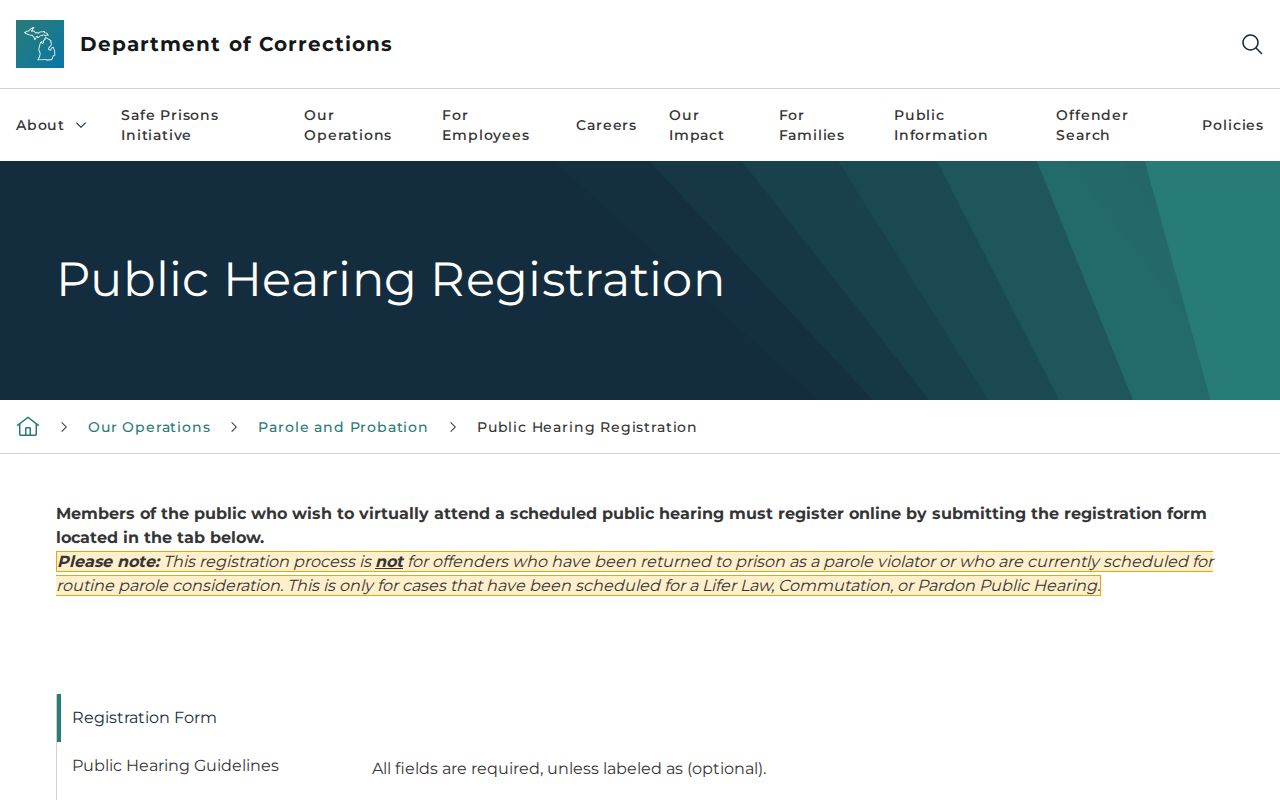
Readers should use the registration page only for proceedings it expressly lists and verify an actual release through MDOC records.
Mecosta Supervision Discharge Records
Supervision ends through lawful discharge, not through a missing search result or a period without contact. OTIS uses “discharged” to show that MDOC jurisdiction ended. A Date Paroled records the move from prison into parole, so it is not the same as the later discharge. For an MDOC case, status, Date Paroled, supervision information, and maximum-discharge data should be read together.
OTIS generally keeps a discharged person in public results for three years after supervision discharge. For older records, MDOC directs past-prisoner inquiries up to six years after release to its Records Retention contact, while older archival questions may go to the Archives of Michigan. A narrowly worded MDOC FOIA request may seek releasable discharge or sentence material. The public cannot use the limited PENPACK process as a general shortcut because MDOC reserves that certified package for recognized criminal-justice authorities.
A county jail release is different. If a Mecosta County case ended without MDOC parole or felony probation, the durable proof is usually the sheriff booking/release record and the court docket. The full county-jail release path is covered on the Mecosta County released-inmate search, while state date fields are explained under Mecosta County projected release.